
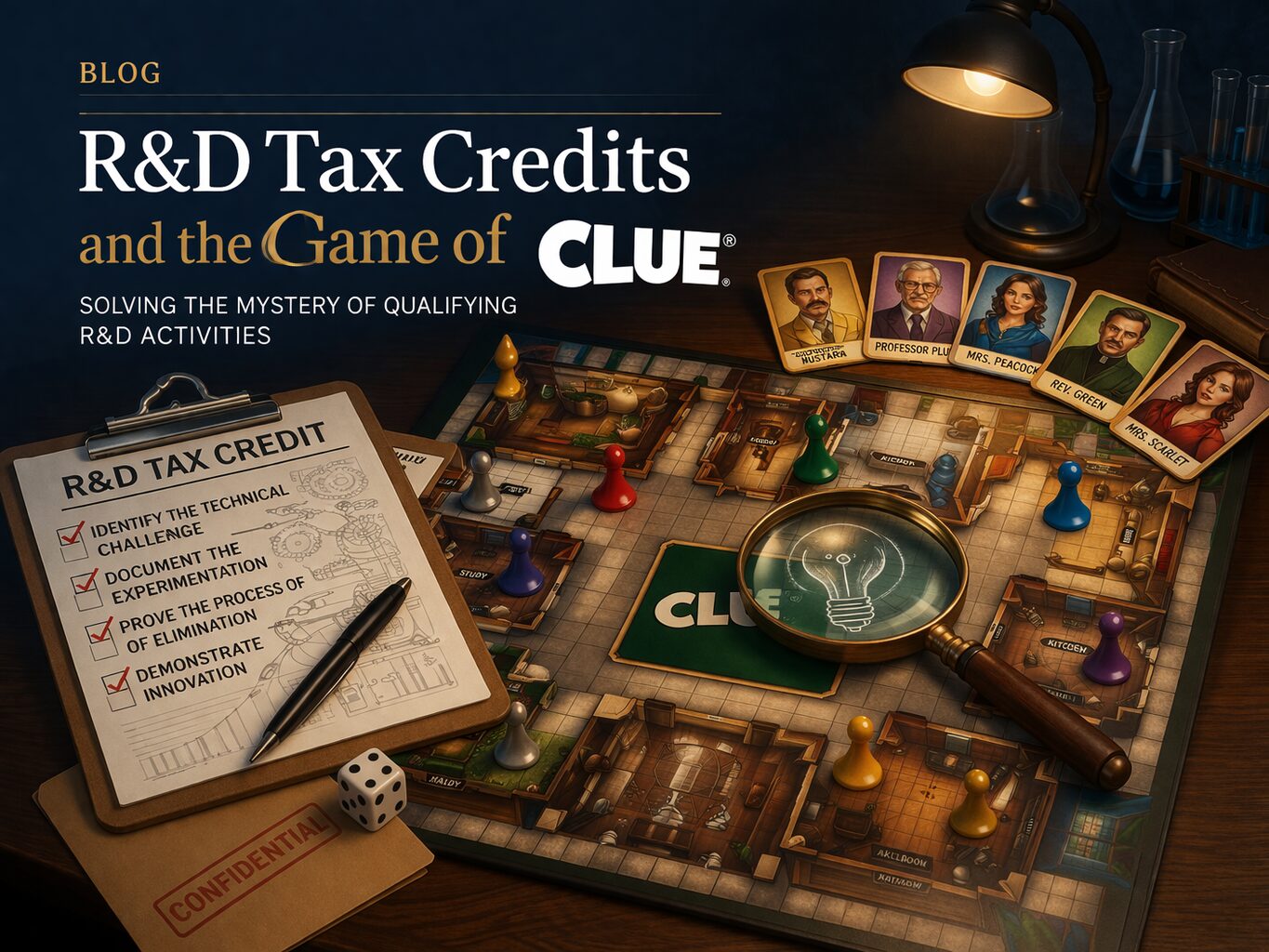
Identifying Qualified Research Expenses (QREs) is rarely straightforward. Tax teams spread qualifying work across teams, systems, and project records, and the costs that qualify rarely surface on their own. In structure, an R&D tax credit study closely resembles the investigative logic of the board game CLUE: specialists work backward from available evidence to determine who performed qualifying work, where it happened, and which expenses can be claimed. Miss a clue, and you leave credits on the table. Misread one, and you create audit exposure.
The Board Is Set: Your Company’s Projects
In CLUE, the board defines the boundaries of the investigation: rooms, weapons, and suspects. In an R&D tax credit study, the board is the company itself; its projects, teams, and expense records. Work that appears routine on the surface often contains qualifying research activity: engineers resolving design uncertainty, developers iterating on architecture, scientists testing formulas under controlled conditions. As a result, the specialist’s job is to recognize those activities for what they are and build a record that supports the claim.
The Suspects: Employees and Project Contributors
In CLUE, identifying the right suspect requires asking the right questions. In an R&D tax credit study, the equivalent is the SME interview process. Engineers, scientists, designers, and developers hold firsthand knowledge of what actually happened on a project; the iterations, the failures, the technical uncertainty that teams never documented formally. Specialists ask targeted questions to surface that detail. A single conversation can reveal a process of experimentation that transforms an ordinary project record into a defensible QRE. Missing a key contributor is the equivalent of overlooking a suspect: the case becomes harder to close.
The Rooms: Where Innovation Happens
In CLUE, the room establishes where the event occurred and which evidence is relevant. In an R&D tax credit study, location shapes which costs are in scope. A testing lab, a software development environment, a prototype workshop, or a remote engineering team can each generate direct QREs, but only if the team connects the work performed there to qualifying research activities. Specialists map where research happened so that expense allocations reflect actual work patterns rather than organizational assumptions, and so no location goes overlooked.
The Weapons: The Costs That Qualify
In CLUE, the weapon connects a suspect to the event. In an R&D tax credit study, the equivalent is the expense itself: wages paid to qualifying employees, materials consumed in testing, contract research costs, and cloud or software expenses directly tied to research activities. Specialists must trace each cost to a specific qualifying activity and document it accordingly. Furthermore, costs that lack a direct connection to the research are excluded regardless of how the company classified them internally. Therefore, every dollar claimed requires a defensible rationale, because assumptions about what qualifies are precisely what examiners test.
Gathering Evidence: The Detective Work
Winning at CLUE requires evidence from multiple sources, not a single confident guess. R&D tax credit studies work the same way. Specialists review project plans, design iterations, test results, meeting notes, and internal communications to reconstruct the research process. They rule out activities that do not qualify and build a record around those that do. Consequently, the goal is documentation that does not depend on verbal explanation during an examination—records that stand on their own and connect technical work to tax conclusions without requiring a specialist to walk an examiner through them in real time.
Piecing Together the Case: Who, Where, and What
In CLUE, the goal is to identify who committed the crime, where, and with what. In an R&D tax credit study, the goal is to determine:
- Who performed the qualifying work?
- Where did the research take place?
- What expenses can be claimed as QREs?
This structured approach ensures that specialists capture qualifying work completely and can defend each element of the claim independently. Missing a “who,” “where,” or “what” is the equivalent of losing a critical clue — the case becomes incomplete, and the credit becomes vulnerable.
Strategy Matters: Planning Your Moves
Winning CLUE is not about random guesses; it is about building a case methodically from available evidence. Maximizing R&D tax credits requires the same discipline. Documenting work as it happens, tracking project iterations, and analyzing costs in real time ensures that no qualifying expense goes uncaptured and that the claim reflects what the company actually did. A proactive approach also reduces audit risk. In contrast to claims assembled retrospectively at filing time, specialists can connect every QRE to specific evidence gathered throughout the year, which makes the claim significantly more durable under IRS review.
Conclusion: Turn Your R&D Activity Into a Winning Case
R&D tax credits reward companies that treat the qualification process like the investigation it actually is. Every project is a potential scene, every employee a potential witness, and every expense a potential piece of evidence. The teams that capture the most credit are not the ones with the most activity. Rather, they are the ones with the most disciplined approach to finding, connecting, and documenting what qualifies. If your team wants to pressure-test whether your current process is capturing every QRE available to you, MASSIE can help.

June 24, 2026
2:00 pm EST





 The 6765 Business Component Solution
 Full Outsource
 Big 4 to In-House
 Reverse Audit
 State Tax Incentives
 Tax Controversy
 R&D Staffing Services
 174 Assistance