
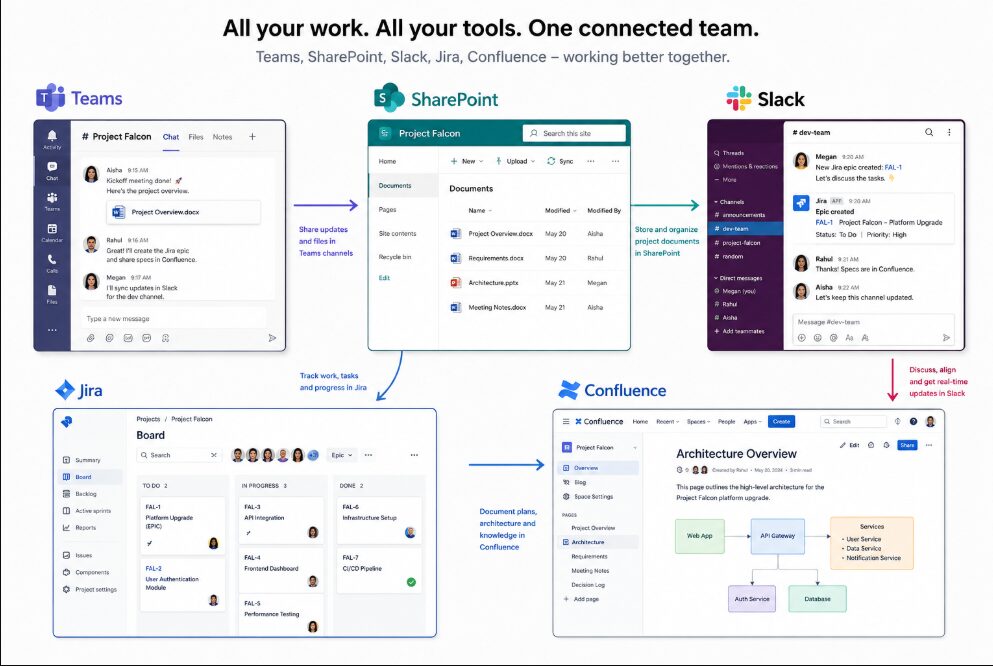
Most large companies already own the technology needed to document their R&D tax credit work. Teams, SharePoint, Slack, Jira, Confluence. The tools are there. The question we hear constantly is why so few companies actually use them well for this purpose, and whether a dedicated R&D tax credit platform would solve the problem instead.
We work through this question with clients regularly, and the answer is rarely as simple as buy new software or fix what you have. Below are the concerns we hear most often, and what we think is actually driving each one.
“Our Collaboration Tools Are Disorganized”
This is the concern we hear first, almost every time. Companies have Teams, SharePoint, Slack, and Jira, but the information that matters is scattered across dozens of channels, folders, and workspaces with no consistent structure.
The honest version of this concern usually sounds something like: just because we have the tools does not mean we have a process. That is exactly right, and it is also the core of the issue. The technology is not the problem. Governance and structure are the problem, and no amount of new software fixes a missing process on its own.
“Our Documentation Isn’t Created with Tax in Mind”
Engineers build documentation to ship products, not to support a tax credit study. That is a reasonable design choice for engineering, and it creates a real gap for tax.
Technical documentation often does not address uncertainty in the way the four-part test requires. Project files may not clearly identify which activities are qualified research. The evidence engineers naturally produce does not always line up with what the IRS expects to see in an examination. None of that means the underlying work does not qualify. It means someone has to build a framework that translates operational documentation into tax-supporting documentation, and that framework has to exist regardless of which platform houses the source material. We have written about how tax teams are using AI safely to support this kind of documentation, and the same principle applies here. The tool matters less than the framework behind it.
“We Need Consistency Across Multiple Locations”
Large organizations operate across different business units, different engineering teams, and different documentation practices. A specialized platform can look appealing here because it appears to force a standardized process across the enterprise.
It is worth pausing on that word, appears. A platform can standardize where information lives. It cannot, by itself, standardize how people decide what to document or how thoroughly they do it. Consistency comes from a defined process applied the same way everywhere, not from a shared login.
“We Don’t Want Tax Documentation Mixed with Operational Documentation”
Some companies prefer a dedicated repository for tax-related records, separate from day-to-day engineering documentation. The reasoning usually touches on access controls, retention requirements, audit preparation, and legal review considerations.
These are legitimate administrative concerns, and a separate environment can simplify some of them. But separation is an administrative choice, not a substantiation requirement. The IRS does not care whether your records sit in a dedicated tax repository or a well-organized folder inside your existing systems. It cares whether the records are reasonable, consistent, and inspectable.
“Our SMEs Already Ignore Teams and Email”
This concern gets at something real that often gets missed in the technology conversation. Simply moving a request from email into Teams does not guarantee participation if the request itself is poorly designed.
Engineers are already overwhelmed. A vague request for documentation, regardless of which platform delivers it, tends to get the same response: low priority, deal with it later. The fix is not a new inbox. It is a better-designed request that respects how SMEs actually work and asks for something specific, not “tell us about your R&D this year.”
“We Need Better Reporting and Analytics”
Dedicated R&D tax software typically comes with project dashboards, resource tracking, QRE reporting, and workflow metrics built in. That is a genuine advantage out of the box.
Collaboration tools can often produce similar visibility, but it usually takes additional configuration to get there. This is one of the few areas where dedicated software has a real, structural edge rather than just a process gap dressed up as a technology gap. If reporting and analytics are the primary pain point, that is a more legitimate reason to consider specialized software than most of the other concerns on this list.
“We Have High Employee Turnover”
When key personnel leave, institutional knowledge often leaves with them. This is a real risk, and it is one of the stronger arguments for more structured, searchable documentation systems.
A specialized platform can help preserve information in a more structured format. So can a well-organized SharePoint site or Confluence space with a consistent taxonomy and clear ownership. The structure matters more than the brand name on the login screen. Turnover risk is a documentation discipline problem first and a platform problem second.
“We Need a Defensible Audit Package”
This is the concern that comes up most often when the conversation turns to risk. Some taxpayers assume a dedicated R&D platform automatically produces stronger audit support, and the underlying question is usually some version of: will the IRS view documentation stored in Teams or Slack as sufficient?
The answer is generally that the IRS cares more about the quality and timing of documentation than where it is stored. A disorganized file in expensive, purpose-built software is no more defensible than a disorganized file in Teams. A well-organized, contemporaneous record in Teams holds up just as well as the same record in a dedicated platform. Storage location is not a substantiation standard. Reasonable, consistent, and inspectable is the standard, and that can be satisfied in either environment. We have also written about why audit-ready R&D credits often fail under real IRS review, and the platform a company used was rarely the reason.
The MASSIE Response
This is where our position becomes pretty clear after working through enough of these conversations.
The question is not whether collaboration tools are better than dedicated software. The real question is whether your organization is getting value from the technology it already owns.
For some companies, specialized software genuinely makes sense, particularly where reporting and analytics are the binding constraint. For many others, the biggest gap is not a lack of technology. It is a lack of process, structure, and SME engagement. Adding another platform on top of that gap does not close it. It just gives the same underlying problem a new address.
Before investing in a new system, it is worth asking a more basic question: if we fixed the process and structure inside the tools we already have, would we still need to buy something new? For a meaningful number of companies, the answer turns out to be no.
If you are weighing this decision, we are happy to talk through what would actually move the needle for your organization.

September 24, 2026
2:00 pm EST



 The 6765 Business Component Solution
 Full Outsource
 Big 4 to In-House
 Reverse Audit
 State Tax Incentives
 Tax Controversy
 R&D Staffing Services
 174 Assistance